Luxury ecommerce is changing again.
For years, brands focused on traditional SEO, paid ads, email, and social media to get discovered online. Those channels still matter, but now there is a new layer that luxury brands cannot afford to ignore: AI shopping and AI search. This shift is a core component of modern Digital Marketing for Jewelry.
Shopify’s agentic storefronts are a big part of that shift. They help make your products discoverable inside AI experiences like ChatGPT, and Shopify says they are active by default for eligible stores. That means your products can start showing up when shoppers ask AI tools for recommendations, product ideas, or help finding something specific.
For luxury ecommerce brands, this matters because the way people discover products is starting to change. More shoppers are moving away from typing simple searches into Google and are starting to ask AI tools real questions like:
- What is the best luxury gift under $1,000?
- What is a good minimalist gold bracelet for everyday wear?
- Which leather tote feels premium but still practical for travel?
- What is the best automatic watch for someone buying their first luxury timepiece?
If your store is optimized for this new environment, your products have a better chance of showing up in those conversations. If it is not, you could miss a major new discovery channel.
What Are Shopify’s Agentic Storefronts?
Shopify agentic storefronts let AI channels access the product information they need to recommend your products more accurately, including details like titles, descriptions, images, pricing, and availability. This feature is integrated directly into Luxury Shopify Development Services, allowing AI to act as a discovery-focused referrer.
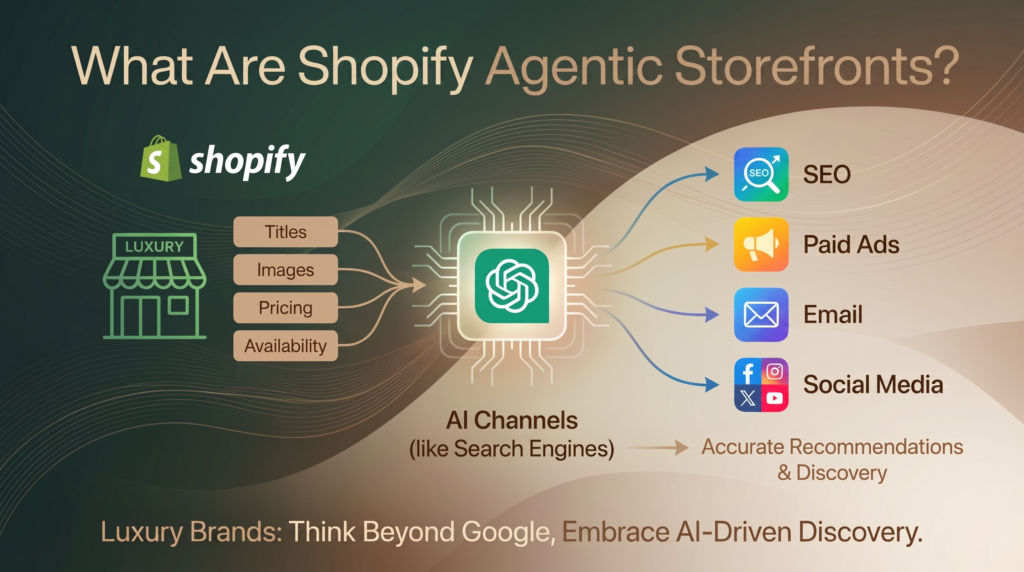
The easiest way to think about this is to compare it to search engines. Google crawls your website so it can understand your pages and decide what to rank. AI shopping tools are now doing something similar. They need clean, useful, structured information so they can understand what you sell and when your products are relevant for a shopper’s request.
That means luxury brands now need to think beyond just ranking in Google. They also need to think about how their products appear in AI-driven discovery.
Why This Matters So Much for Luxury Brands
Luxury shoppers often do more research before they buy. They compare styles, materials, craftsmanship, pricing, and brand positioning. They want reassurance. They want recommendations. They want context. AI tools fit naturally into The Buyer’s Journey because shoppers can ask detailed questions and get curated answers quickly.
That creates a major opportunity for luxury ecommerce brands. If your Shopify store is set up well, AI tools may be able to surface your products when high-intent shoppers are looking for ideas, comparisons, or recommendations. For a luxury brand, that is powerful. You are not just fighting for clicks anymore. You are fighting to be included in the recommendation itself.
Why Leaving It on by Default Is Not Enough
Yes, simply being eligible and active can help. But that does not mean your store is fully optimized.
This is where a lot of brands will fall behind. They will assume that because Shopify has turned on agentic storefronts, they are covered. In reality, the brands that win will be the ones that actively improve how AI systems interpret their products, policies, and brand story. This is the new frontier of SEO for Jewelers.
Shopify’s own guidance makes that clear. The company recommends using clear product titles, compelling summaries, and structured product attributes to improve visibility. In other words, this is not a passive channel. It is a new optimization layer.
How to Optimize Your Shopify Store for Better AI Results
If you run a luxury ecommerce brand, here are some of the biggest areas to focus on.
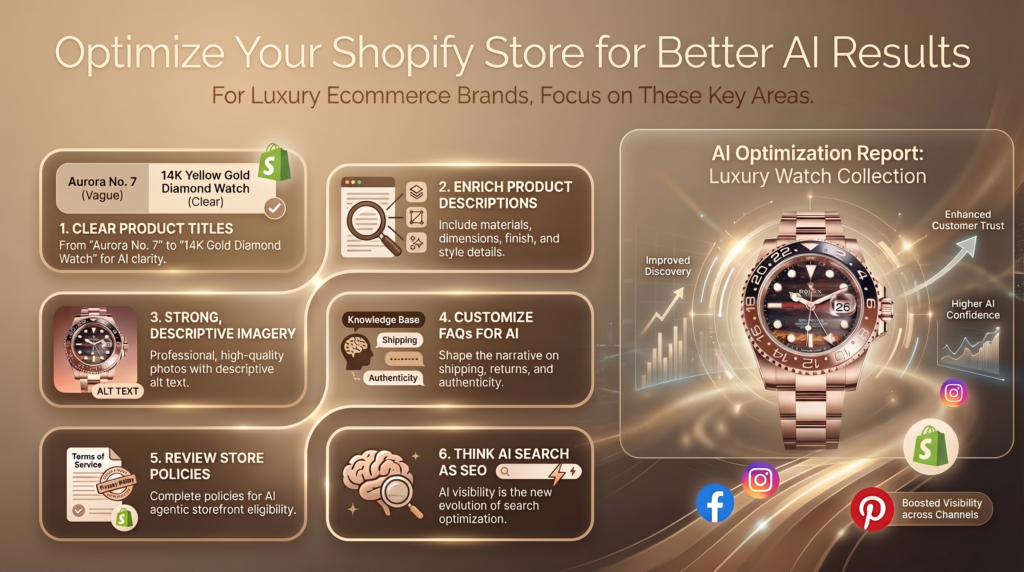
1. Tighten Up Product Titles
Your product titles need to be clear enough for both humans and AI systems to understand quickly.
For luxury brands, there is often a temptation to lean too hard into creative naming. That can work for branding, but it can also reduce clarity. AI tools need clear signals.
A title like:
Aurora No. 7
may sound elegant, but it tells an AI very little.
A title like:
14K Yellow Gold Diamond Tennis Bracelet
gives much more context right away.
You can still maintain a luxury feel, but clarity is the foundation of On-Page SEO.
2. Improve Product Descriptions
Thin product descriptions are going to become an even bigger problem in the AI era.
If your description only says that something is timeless, elegant, or beautifully crafted, that is not enough. AI tools need richer detail to understand what makes the product relevant for certain types of shoppers.
Strong product descriptions should include:
- materials
- dimensions
- finish
- style details
- intended use
- wearability
- giftability
- category context
- care information
Shopify specifically recommends comprehensive product descriptions, technical details, comparison information, and product attributes when optimizing for AI.
3. Make Sure Images Are Strong
Images already matter for conversion, but they also matter for discovery. Professional imagery is a key part of UX Design.
Shopify says product data shared with AI channels can include images, and its AI optimization guidance recommends high quality images with descriptive alt text.
For luxury brands, that means:
- polished primary product images
- clean white background shots
- premium lifestyle imagery
- accurate color representation
- close ups that show texture and craftsmanship
- alt text that describes the product clearly
The more complete and high quality your assets are, the better chance you have of making a strong impression when AI tools present your products.
4. Customize the Knowledge Base and FAQs
This is one of the biggest opportunities that many brands will overlook.
Shopify offers a free Knowledge Base app that lets merchants view and customize the FAQs AI shopping agents use. This is a form of Marketing Automation that lets you shape the narrative on shipping, returns, authenticity, and brand positioning.
For luxury ecommerce, this is huge.
It gives you a way to shape how AI answers questions about:
- shipping
- returns
- materials
- custom work
- sizing
- warranty
- authenticity
- gift packaging
- showroom appointments
- brand positioning
If you do not customize this layer, AI may rely too heavily on generic or incomplete information. If you do customize it, you have a better chance of shaping the narrative.
5. Review Store Policies and Business Information
Shopify says eligible stores need completed policies such as terms of service, privacy policy, and return and refund policy for the ChatGPT agentic storefront. Shopify also recommends adding business settings for visibility across Shop and AI related discovery surfaces.
For luxury brands, this matters for two reasons.
First, it helps with eligibility and completeness.
Second, clear policies help AI tools answer customer questions more confidently. Luxury shoppers often want reassurance before buying, especially on higher ticket items.
6. Think About AI Search Like the Next Evolution of SEO
This is probably the most important mindset shift.
Traditional SEO is still important. But now luxury brands should start thinking about AI visibility as another form of search optimization.
That means asking questions like:
- Does our product page explain the item clearly?
- Does our site make our brand easy to understand?
- Are our product attributes detailed enough?
- Are our FAQs helping AI give accurate answers?
- Are our product pages written only for style, or also for clarity?
The stores that take this seriously now may have a major advantage later.
What This Could Mean for the Future of Luxury Ecommerce
Luxury ecommerce has always depended on presentation, trust, and discovery.
What is changing is where that discovery happens.
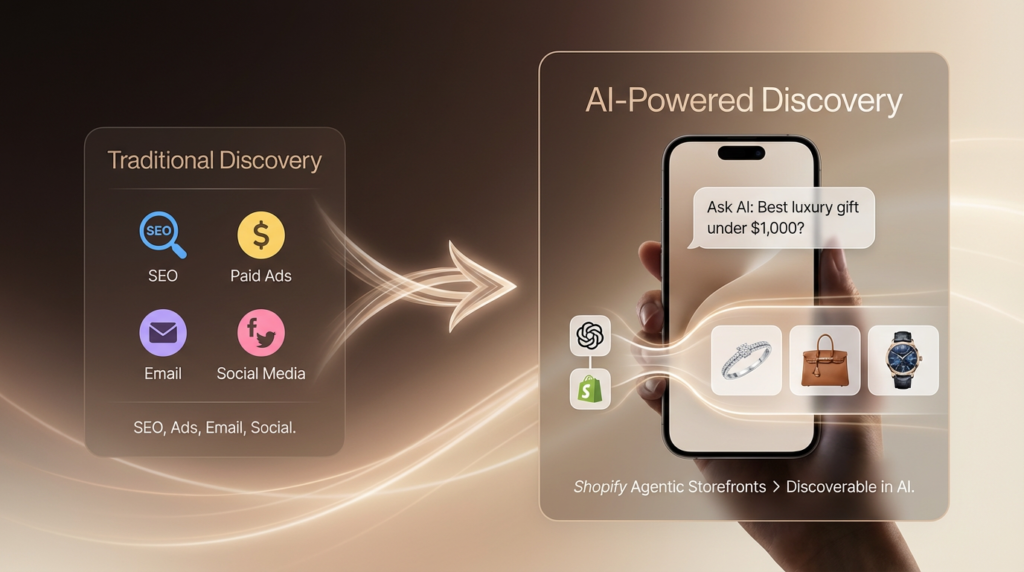
Instead of relying only on Google rankings, Instagram content, and paid ads, luxury brands are entering a world where AI tools can recommend products directly during the research phase. Shopify’s broader agentic commerce documentation also shows the company is building for a future where AI agents can search catalogs, answer policy questions, manage carts, and support checkout flows.
That is a meaningful shift.
It means product data, store structure, and AI-readable content are becoming even more valuable. This requires specialized Jewelry Marketing Services to ensure your data is cleaner and more visible than the competition.
And it means luxury brands should stop treating this like a small feature update.
This is closer to the beginning of a new discovery channel.
Final Thoughts
Shopify’s agentic storefronts could change the future of luxury ecommerce because they move product discovery into AI conversations, not just search results pages. Luxury brands that improve their product titles, descriptions, imagery, and FAQs now will be in a much better position as AI shopping grows.
At ARKTOP, we help luxury ecommerce brands stay ahead of digital shifts like this one. From Luxury SEO and product page strategy to conversion-focused design, we help brands build stores that are easier to find and easier to trust.
Schedule a strategy consultation with ARKTOP today and let’s build an AI-ready digital experience for your brand.