Most jewelers can tell you the exact cost of their last parcel of loose stones, down to the carat. Ask about last quarter’s marketing spend and the answer usually softens into a range, a shrug, or a number someone in accounting would have to look up.
That gap matters more in 2026 than it did five years ago. AI-generated answers now sit above the organic results for a growing share of jewelry searches, paid media costs continue to climb, and the customer who walks into your showroom has usually spent weeks researching before you ever meet them. A jewelry store digital marketing budget is no longer a discretionary line item you top up when business slows. It’s the mechanism that decides whether you’re part of that research phase or invisible during it.
This guide gives you the benchmarks: what percentage of revenue jewelers typically commit, what each channel actually costs, how to split the total across a working mix, and what agency pricing should look like at different service levels. By the end, you’ll have a defensible number and a clear way to hold it accountable.
What a Jewelry Store Digital Marketing Budget Actually Covers
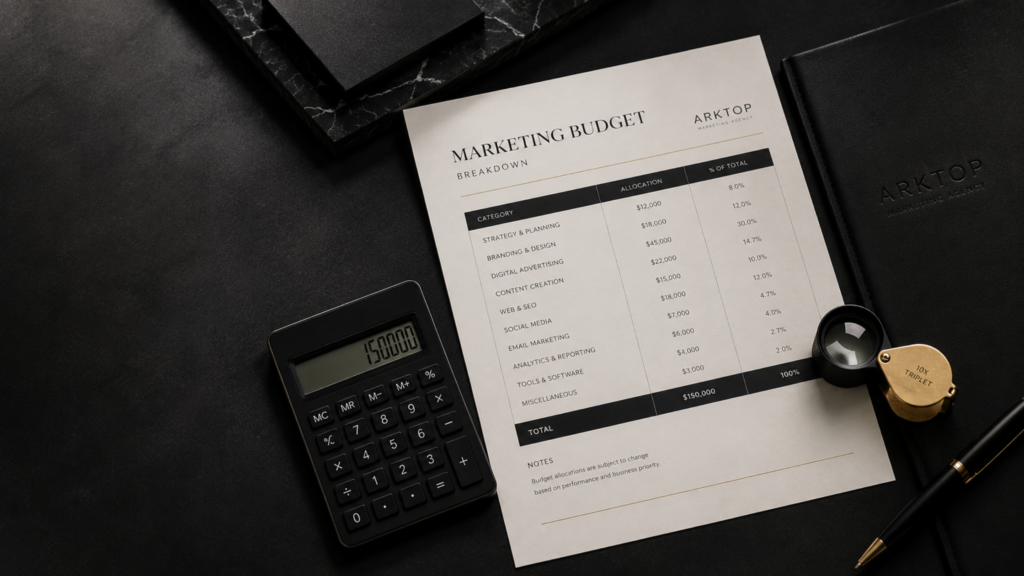
Before you can set a number, you need agreement on what the number includes. Many jewelers underestimate their budget because they’re only counting ad spend, and many overestimate it because they’ve folded in costs that belong elsewhere.
A complete digital marketing budget typically includes:
- Media spend: the dollars that go directly to Google, Meta, and other ad platforms
- Management fees: what you pay an in-house specialist or agency to run those campaigns
- Content production: photography, video, blog writing, and product descriptions
- SEO and AI search work: on-page optimization, site structure, local listings, schema, and entity visibility
- Website maintenance: hosting, security, page speed work, and ongoing improvements
- Software and tools: email platform, CRM, GA4 and analytics, review management, and scheduling
- Creative and design: ad creative, landing pages, and seasonal campaign assets
Costs that sit in a gray area
A full website rebuild is usually a capital expense rather than a recurring marketing cost, though it’s worth reviewing when your site is due for an update before you finalize the year’s figure. Trade shows and print advertising belong in your broader marketing budget, but not in the digital line.
Get this scope written down first. A budget built on an undefined scope will always feel like it’s underperforming, because you’ll keep discovering costs it was never sized to carry. If you haven’t yet built the surrounding framework, start with what a marketing plan should include.
Marketing Budget Percentage of Revenue: Retail Benchmarks to Start From
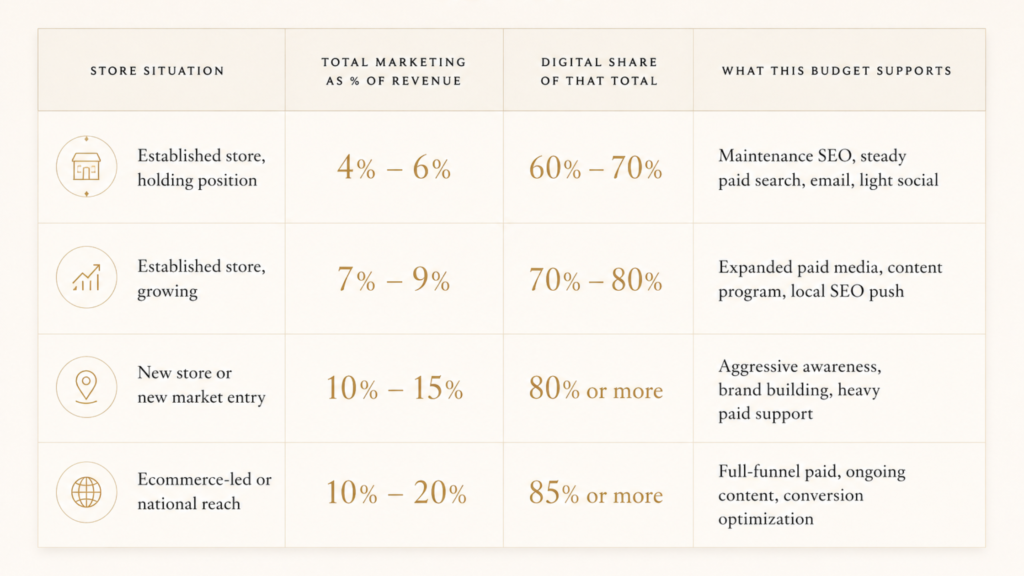
Most retailers set their marketing budget as a percentage of revenue, working backward from annual sales. For jewelry retail, that figure generally lands between 4% and 12% of revenue for established operations, with growth-stage and e-commerce-led stores pushing higher.
Jewelry occupies an unusual position in that range. An established store with existing local visibility can hold its position at the lower end. A store in a competitive metro, entering a new market, or building an online channel routinely needs the upper end, because high average order value, long consideration cycles, and heavy competition for a relatively small pool of high-intent searches all push the requirement up.
| Store situation | Total marketing as % of revenue | Digital share of that total | What this budget supports |
| Established store, holding position | 4% to 6% | 60% to 70% | Maintenance SEO, steady paid search, email, light social |
| Established store, growing | 7% to 9% | 70% to 80% | Expanded paid media, content program, local SEO push |
| New store or new market entry | 10% to 15% | 80% or more | Broad awareness, brand building, sustained paid support |
| E-commerce-led or national reach | 10% to 20% | 85% or more | Paid coverage from awareness through purchase, ongoing content, conversion rate optimization |
Two adjustments to make before you accept any of these figures:
Your gross margin sets the ceiling. A store operating on 45% margins can sustain a meaningfully higher spend rate than one at 30%.
Your starting visibility sets the floor. If you’re not appearing in local search results today, a 4% budget will not move you into them.
Digital Marketing Cost for Jewelers, Channel by Channel
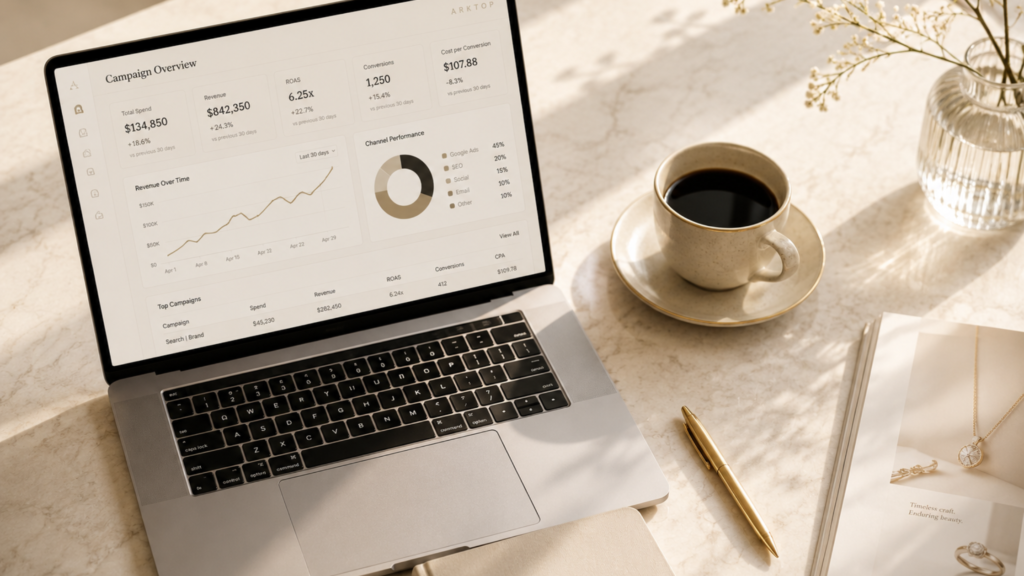
Percentages are useful for sizing the total. They’re less useful when a vendor quotes you a monthly figure and you need to know whether it’s reasonable. The table below reflects typical monthly digital marketing cost for jewelers at the independent and multi-location retail level.
| Channel | Typical monthly range | What it includes | Time to meaningful results |
| SEO | $1,500 to $6,000 | Technical fixes, content, on-page work, authority building | 4 to 9 months |
| Local SEO | $500 to $2,500 | Google Business Profile, citations, review generation, local pages | 2 to 5 months |
| AI search visibility (GEO) | $500 to $2,500 | Entity optimization, structured data, citation building, answer-engine monitoring | 3 to 6 months |
| Google Ads (media) | $2,000 to $15,000+ | Search, Shopping, Performance Max placements | Immediate, optimizes over 60 to 90 days |
| Paid social (media) | $1,500 to $10,000+ | Meta, Pinterest, and TikTok placements | 2 to 8 weeks |
| Paid management fees | 10% to 20% of spend, or $1,000 to $4,000 flat | Strategy, build, optimization, reporting | Ongoing |
| Email marketing | $300 to $1,500 | Platform, flows, abandoned cart recovery, campaign design, list growth | 30 to 60 days |
| Content and creative | $1,000 to $5,000 | Blog, product copy, photography, video, ad creative | 3 to 6 months compounding |
| Website maintenance | $200 to $1,500 | Hosting, security, speed, minor updates | Ongoing |
A few notes on where jewelers commonly misjudge these numbers:
Paid search is bid-driven, not fee-driven
Bridal and branded watch terms carry some of the highest costs per click in retail, so a modest budget in a competitive metro may only capture a fraction of available demand. Understanding how to calculate PPC ROI matters more than the raw spend figure.
SEO pricing reflects scope, not quality
A $1,500 engagement and a $6,000 engagement often differ in content volume and technical depth rather than skill. A clear picture of how SEO works helps you read those proposals accurately.
AI search is a new line, not an optional one
When an AI-generated answer summarizes “best jewelers in [city]” before a customer clicks anything, the question is whether your store is cited in that summary. This work overlaps with SEO but isn’t identical to it. It depends on structured data, consistent entity signals, and being referenced by sources the models already trust. Budget for it separately so it doesn’t quietly get absorbed into a content line.
Email returns the most per dollar
If your budget is tight, protect this line before any other. Automated email flows like abandoned cart recovery, post-purchase follow-up, and anniversary reminders keep producing revenue during months when paid spend is paused.
How to Allocate Your Jewelry Marketing Budget Across Channels
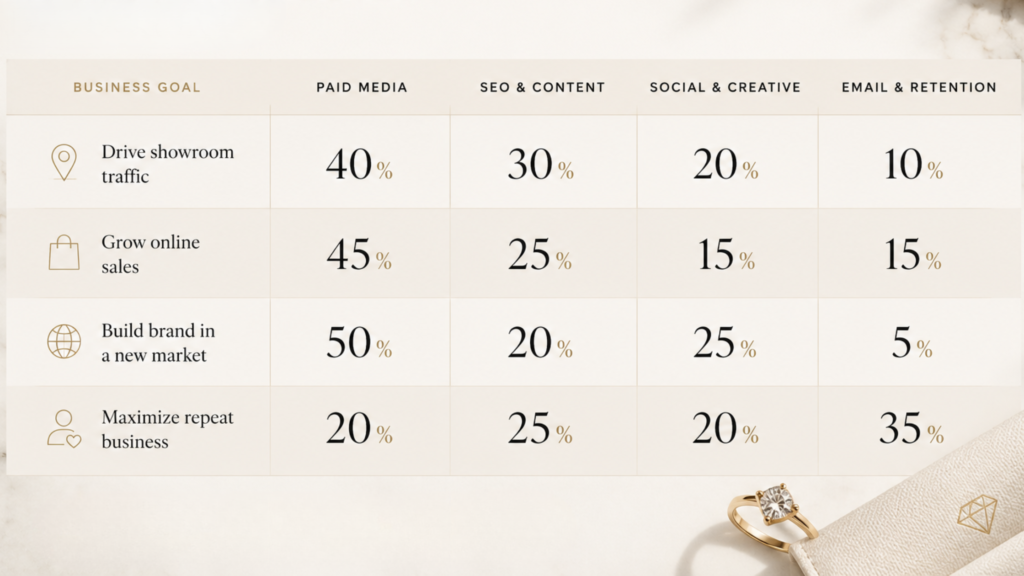
Once you’ve set the total, allocation becomes the decision that determines return. The right split depends on what you’re trying to accomplish this year, not on what worked for a store in a different market.
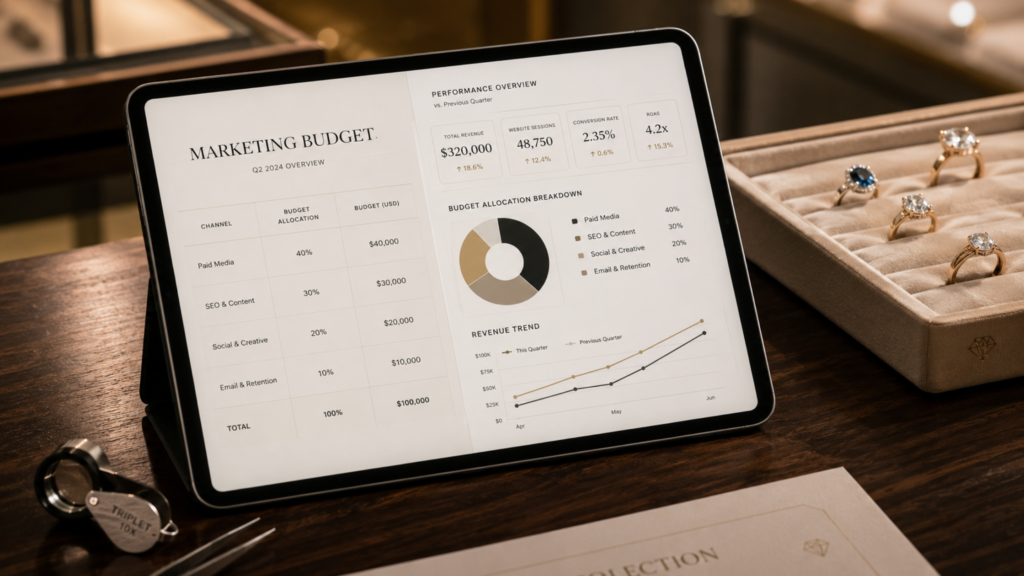
| Primary goal | Paid media | SEO, GEO, and content | Social and creative | Email and retention |
| Drive showroom traffic | 40% | 30% | 20% | 10% |
| Grow online sales | 45% | 25% | 15% | 15% |
| Build brand in a new market | 50% | 20% | 25% | 5% |
| Maximize repeat business | 20% | 25% | 20% | 35% |
Three principles worth applying to whichever row fits you:
Local visibility earns its allocation first. For any store with a physical showroom, local SEO typically delivers the strongest return per dollar committed.
Social requires production, not just placement. Budgeting media dollars without funding creative leaves you running the same three assets for a quarter.
Reserve 10% as a flexible tier. Seasonal spikes, competitor moves, and unexpected performance all warrant reallocation mid-year
Jewelry Marketing Agency Pricing: What You’re Paying For
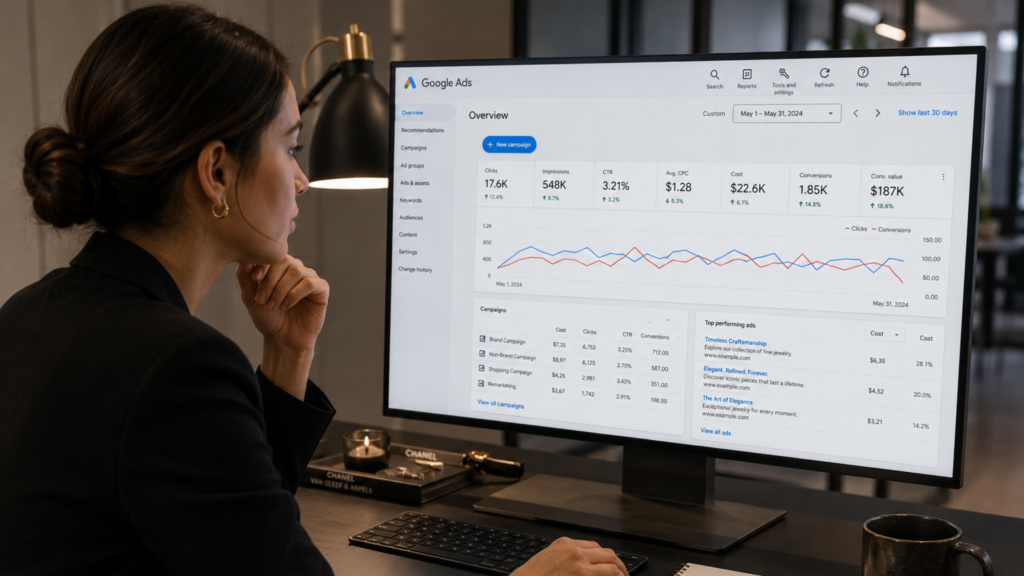
Jewelry marketing agency pricing varies widely, and the variance is rarely about talent alone. It reflects scope, seniority, reporting depth, and whether the agency has worked inside the jewelry category before.
| Pricing model | Typical structure | Best suited for |
| Monthly retainer | $2,500 to $15,000+ | Ongoing multi-channel programs |
| Percentage of ad spend | 10% to 20% of media | Paid-heavy accounts with variable budgets |
| Project-based | $3,000 to $50,000+ | Website builds, rebrands, campaign launches |
| Hourly consulting | $150 to $350 per hour | Audits, strategy sessions, in-house support |
Questions worth asking before you sign anything:
- Who is doing the actual work, and what is their experience in luxury retail?
- Is media spend included in the quoted figure, or billed separately?
- What is reported monthly, and does it connect to revenue rather than impressions?
- What happens to your accounts, creative, and data if the relationship ends?
Category experience is the variable that most reliably justifies a higher fee. Running paid search for a jeweler carries different bid dynamics, seasonality, and creative requirements than running it for general retail. ARKTOP’s work with Hamra Jewelers and other official Rolex jewelers is built on exactly that specialization, and our jewelry marketing services are structured around it. If you’re still comparing options, our overview of the best digital marketing agencies for jewelers is a useful starting point.
How to Tell If Your Marketing Budget Is Actually Working
A budget without a measurement framework is a guess with a spreadsheet attached. Set the accountability structure at the same time you set the number.
Track these at minimum:
- Cost per acquisition by channel, not blended across all sources
- Return on ad spend for every paid campaign, reviewed monthly
- Conversion rate by traffic source, separated for showroom appointment requests and online purchases
- Organic visibility for your priority commercial terms, tracked separately for national and local results
- Showroom attribution through call tracking, appointment forms, and in-store questions
- Customer acquisition cost measured against average order value and lifetime value
None of this works without clean measurement infrastructure. If your GA4 property still isn’t tracking appointment form submissions, phone taps, and checkout events as proper conversions, fix that before you adjust a single dollar of the budget. Roughly half the jewelry accounts we audit are making allocation decisions on incomplete data.
Give each channel a fair evaluation window
Paid search can be judged in 60 to 90 days. SEO and content require two to three quarters before the data means anything, and cutting those programs at month four discards the investment already made.
Reallocate rather than reduce
If a channel underperforms after a fair window, move the money rather than remove it. The total budget is sized to your revenue goal. Shifting dollars toward what’s converting keeps that goal intact, while trimming the total quietly lowers it. Make reallocation a standing item in your monthly review rather than a reaction to a bad quarter.
Setting a Number You Can Defend
The jewelers who get the most from their marketing aren’t necessarily the ones spending the most. They’re the ones who decided on a percentage, allocated it deliberately, and reviewed it against revenue every quarter instead of every time a slow month arrived.
Start with your revenue goal. Apply the benchmark range that matches your situation. Allocate against your primary objective, protect a flexible tier, and hold each channel to a measurement window that reflects how it actually works.
If you’d like a second opinion on whether your current budget is sized correctly for your market, schedule a consultation with ARKTOP. We’ll review your numbers against what we see working across luxury jewelry retail and tell you plainly where the gaps are.
Frequently Asked Questions
How much should a small jewelry store spend on digital marketing per month?
For an independent store doing $1 million to $2 million in annual revenue, a working digital marketing budget typically falls between $3,000 and $9,000 per month. The lower end covers local SEO, email, and modest paid search for a store holding its position. The upper end supports a full multi-channel program with content and creative production, and generally applies to stores actively pursuing growth.
What percentage of revenue should a jewelry store spend on marketing?
Established jewelry stores holding their position generally commit 4% to 6% of revenue to total marketing, while stores pursuing growth often move to 7% to 9%. New stores and those entering a new market commonly budget 10% or higher during the first 12 to 18 months. E-commerce-led retailers competing nationally can reach 20%.
Is SEO or paid advertising a better use of a limited jewelry marketing budget?
Paid advertising produces results faster, which makes it the practical choice when you need traffic this quarter. SEO delivers a lower long-term cost per acquisition but requires four to nine months before it contributes meaningfully. Most jewelers with limited budgets fund local SEO and a focused paid search campaign simultaneously rather than choosing one.
How much do jewelry marketing agencies charge?
Agency retainers for jewelry retailers typically range from $2,500 to $15,000 per month depending on scope, with paid media management often billed at 10% to 20% of ad spend. Project work such as website builds is quoted separately. Category experience in luxury and jewelry retail usually accounts for a meaningful portion of any pricing difference.
Should ad spend be included in my digital marketing budget?
Yes. Media spend, management fees, content production, tools, and website maintenance all belong in the same digital marketing budget so you can measure total investment against revenue. Separating them tends to produce a figure that looks smaller than your actual commitment.
Do I need a separate budget for AI search visibility?
Not a separate budget, but a separate line within it. AI search optimization overlaps with SEO but depends on different signals: structured data, consistent entity information, and citations from sources the models already trust. Most jewelers should expect to commit $500 to $2,500 per month, drawn from the SEO and content allocation rather than added on top.
How often should a jewelry store review its marketing budget?
Review performance monthly and revisit the allocation quarterly. The total percentage of revenue should be reset annually, or sooner if your revenue moves significantly or you enter a new market.