Most jewelers don’t lose money on advertising because their ads are bad. They lose it because nobody can tell which half of the budget is working.
The right digital advertising resources solve that problem. They give you visibility into what you’re spending, where it’s going, and what it’s bringing back. Without them, you’re approving invoices on faith and hoping showroom traffic holds.
This guide covers the platforms, tools, and tracking systems that luxury jewelers actually use to run smarter campaigns. You’ll finish it knowing which resources belong in your stack, what each one does, and how to tell whether your current setup is producing real answers or just well-designed dashboards.
What Digital Advertising Resources Actually Include
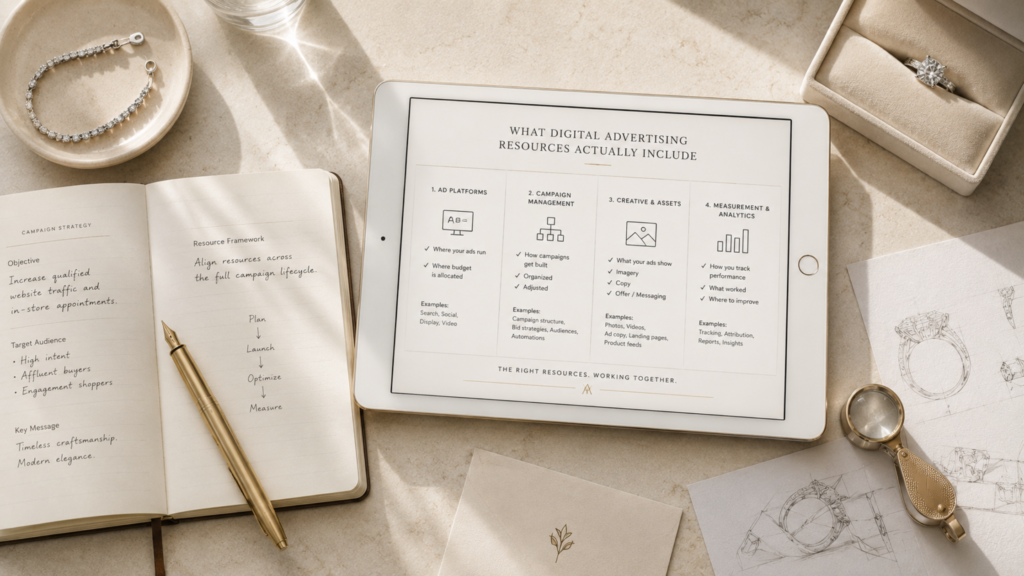
The term covers more ground than most people expect. It isn’t just ad platforms. It’s the full set of systems that plan, launch, manage, and measure paid campaigns.
Think of your resources in four categories:
- Ad platforms: where your ads run and where budget is allocated
- Campaign management tools: how campaigns get built, organized, and adjusted
- Creative and asset resources: what your ads actually show, from imagery to copy
- Measurement and analytics: how you prove what worked
Most jewelry businesses have the first category covered and the last one almost entirely missing. That gap is where budget quietly disappears.
Why the Right Digital Advertising Tools Matter for Jewelers

Luxury buyers move differently than typical retail shoppers. Consideration periods stretch across weeks, purchases often start online and finish in the showroom, and a single sale can carry the value of dozens of ordinary transactions.
That behavior makes the right digital advertising tools essential:
- Longer sales cycles need retargeting. A shopper who viewed an engagement ring in March may buy in May. Without retargeting infrastructure, you lose them.
- High ticket values need accurate attribution. One $18,000 sale can make a campaign profitable. If your tracking misses it, you’ll shut off a winner.
- Offline conversions need to be connected. Showroom visits and phone inquiries matter as much as online checkouts.
- Inventory-driven ads need feeds. Product-level advertising only works when your catalog data is clean and current.
Skip these systems and you end up optimizing toward clicks instead of revenue. Reviewing how to increase conversion rates alongside your ad setup helps close that loop.
Advertising Platforms for Jewelers: Where the Budget Goes
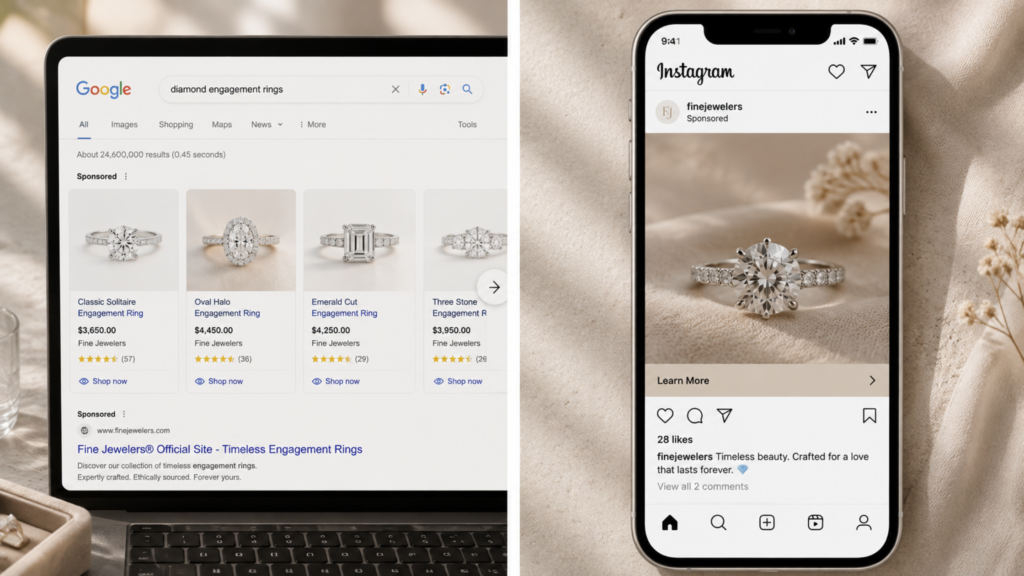
Platform choice sets the ceiling on everything else. Each one serves a distinct role in the buyer’s path, and the strongest programs use two or three in coordination rather than pouring everything into one.
| Platform | Best For | Primary Ad Formats | What to Watch |
| Google Ads | Capturing active buying intent | Search, Shopping, Performance Max | Competitive CPCs on bridal terms |
| Meta (Facebook and Instagram) | Discovery, retargeting, brand storytelling | Image, video, carousel, Advantage+ | Creative fatigue within a few weeks |
| Microsoft Ads | Reaching older, higher-income searchers | Search, Shopping | Smaller volume than Google |
| Early-stage bridal and gift research | Standard and Idea Pins | Long lag between click and purchase | |
| YouTube | Brand building and craftsmanship storytelling | In-stream, Shorts | Harder to attribute directly |
Google and Meta carry the bulk of spend for most luxury retailers. Our Google Ads for jewelry guide and Facebook ads for jewelry brands guide break down the campaign types worth running on each. When accounts grow large enough that daily oversight becomes a full job, luxury Google Ads management and luxury Facebook Ads management take that weight off your team.
Ad Campaign Management Tools That Keep Everything Organized
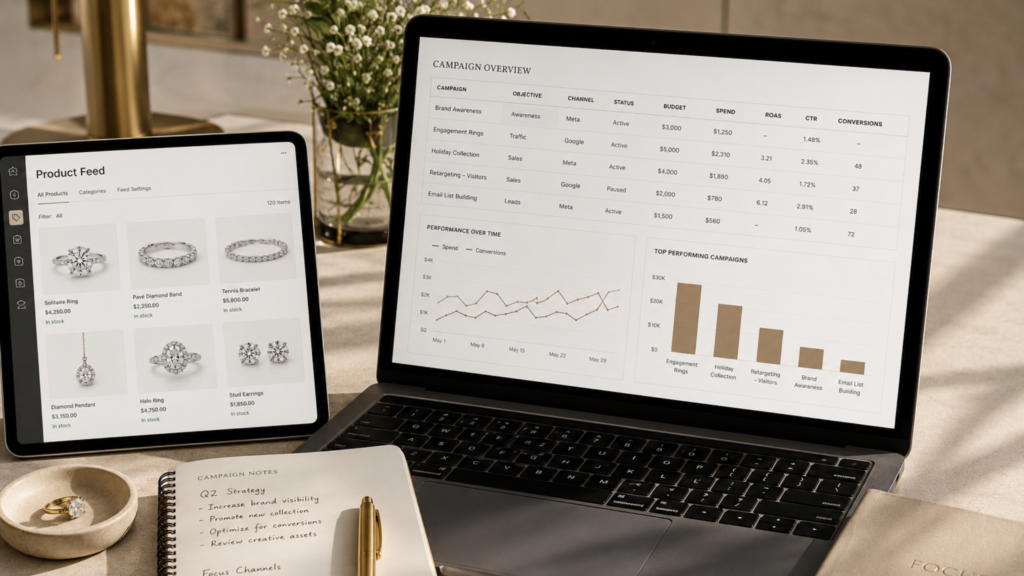
Once budget crosses a few thousand dollars a month, ad campaign management tools stop being optional. They’re what keeps naming conventions consistent, budgets pacing correctly, and creative rotating on schedule.
The categories worth building out:
- Native platform editors. Google Ads Editor and Meta Ads Manager handle bulk edits far faster than the web interfaces.
- Product feed managers. Tools like Feedonomics or DataFeedWatch keep your jewelry catalog formatted correctly for Shopping campaigns.
- Creative asset libraries. A shared, organized library prevents your team from rebuilding the same assets every quarter.
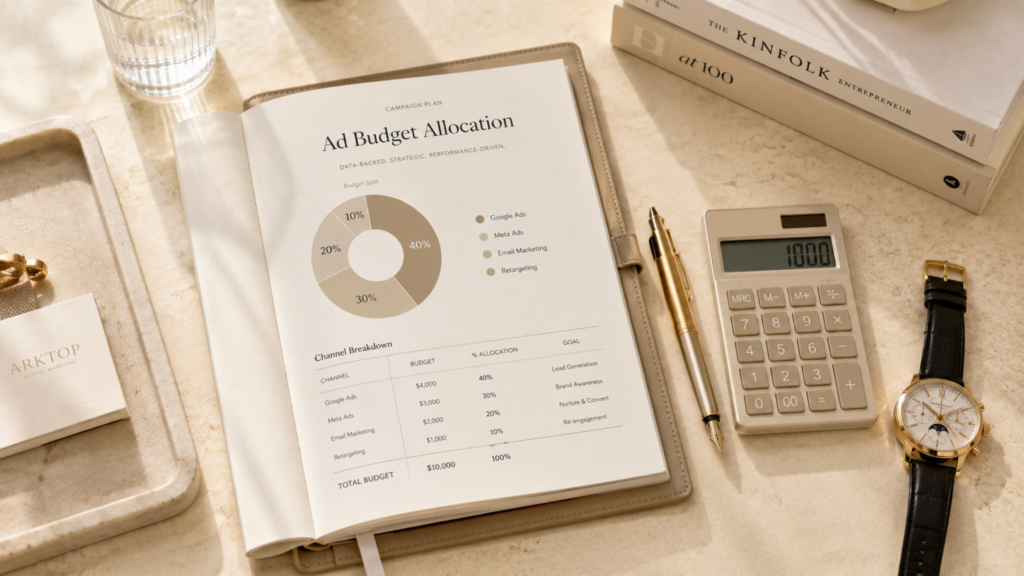
- Budget planning sheets. Simple beats sophisticated here. What matters is that spend is planned before the month starts, not reconciled after.
- Competitor research tools. The Meta Ad Library and Google’s Ads Transparency Center show exactly what other jewelers are running, at no cost.
Shopping campaigns deserve particular attention because they carry so much jewelry revenue. Our walkthrough on setting up Google Shopping campaigns covers the feed and structure decisions that determine performance. Before any of it, settle the number: calculating your PPC budget gives you a defensible starting figure. For the wider stack beyond paid media, our guide to digital marketing tools and resources maps the rest.
Measurement Resources That Prove What Worked
This is the layer that separates advertising from guessing. Every tool here answers a question your ad platform can’t answer honestly on its own.
Build measurement in this order:
- Google Analytics 4 for site behavior, traffic sources, and conversion paths
- Google Tag Manager for deploying tracking without developer bottlenecks
- Conversion tracking configured on every platform, with values assigned to each action
- Call tracking so phone inquiries get credited to the campaigns that produced them
- CRM connection so closed showroom sales feed back into your ad accounts
Analytics only helps if it’s configured correctly, and most jewelry sites aren’t. Our primer on Google Analytics covers the setup mistakes that quietly corrupt reporting for months.
How to Build Your Resource Stack Without Overbuilding It
You don’t need every tool on this list. You need the ones that match your current spend and complexity.
Start here and expand as the program grows:
- Under $3,000 per month: one platform, native tools, GA4 with conversion tracking
- $3,000 to $10,000 per month: two platforms, a product feed manager, call tracking, monthly reporting
- Above $10,000 per month: multi-platform coordination, CRM integration, offline conversion imports, dedicated management
Adding tools ahead of your spend level creates work without creating returns. Adding them too late means you scale something you can’t measure. If you’d rather not manage that transition internally, ongoing PPC management handles the build and the handoff between stages.
ARKTOP’s Role in Smarter Campaigns
Working with Hamra Jewelers and Rolex Official Jewelers taught us that the tools matter less than how they’re connected. A jeweler running three platforms with clean attribution consistently outperforms one running six with none.
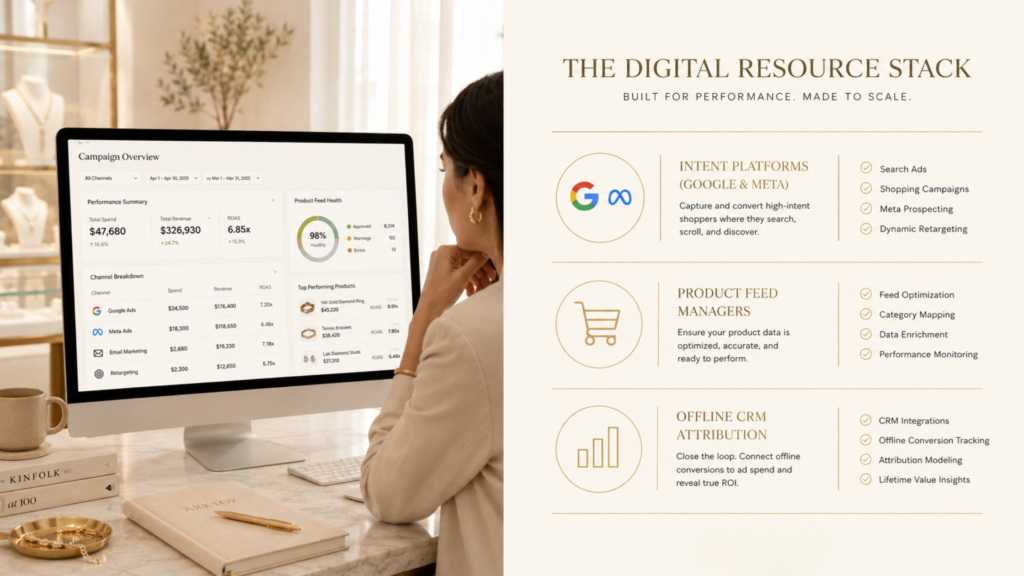
Our jewelry marketing services cover the full stack: platform strategy, campaign build and management, feed maintenance, tracking configuration, and reporting that ties spend to revenue rather than impressions. You get the infrastructure without hiring for it.
Bringing It Together
Digital advertising resources aren’t about collecting software. They’re about knowing, with confidence, which campaigns deserve more budget next month and which ones don’t.
Start with the platforms your buyers actually use. Add management tools when volume demands them. Build measurement first, not last.
If your reporting can’t tell you which campaigns produced showroom appointments last quarter, that’s the gap worth closing first. Book a time with our team and we’ll walk your current setup with you, line by line, and show you what your tracking is missing.
Frequently Asked Questions
What are digital advertising resources?
Digital advertising resources are the platforms, tools, and tracking systems used to plan, run, and measure paid campaigns. They include ad platforms like Google and Meta, campaign management tools, creative asset libraries, and analytics systems. Together they let you see what your ad spend is producing.
Which advertising platform works best for jewelry stores?
Google Ads typically delivers the strongest direct return because it captures shoppers already searching for what you sell. Meta works well for discovery, retargeting, and brand storytelling. Most successful jewelry advertising programs run both, with Google handling intent and Meta handling awareness and follow-up.
How much should a jeweler spend on digital advertising?
Most independent jewelers start between $2,000 and $5,000 per month across platforms, though the right figure depends on your market, inventory, and growth goals. A useful benchmark is 5% to 10% of target revenue. Set the number based on what a customer is worth to you, not on what feels comfortable.
Do I need paid tools, or are free ones enough?
Free tools cover more than most jewelers realize. Google Analytics 4, Google Tag Manager, Google Ads Editor, the Meta Ad Library, and Google Search Console handle the majority of what a growing program needs. Paid tools become worthwhile when feed complexity, reporting demands, or spend levels make manual work unsustainable.
How do I track showroom sales that started with an online ad?
Connect call tracking to capture phone inquiries, use store visit conversions where your account qualifies, and import closed sales from your CRM back into your ad platforms. This gives the platforms real revenue data to optimize against. Without it, high-value offline sales stay invisible and profitable campaigns look like failures.
How long before digital advertising shows results?
Search campaigns can produce inquiries within the first week because they reach people already looking. Social and display campaigns usually need 30 to 60 days to gather enough data to optimize. Given how long luxury purchase decisions take, judge performance over a full quarter rather than a single month.