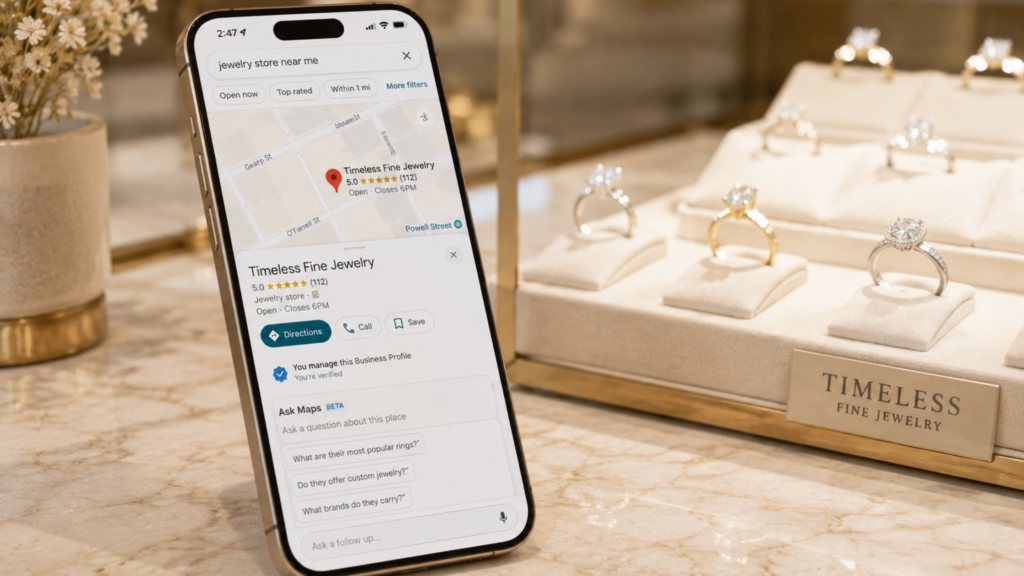
Someone in your market opened Google Maps this morning and typed a full sentence into it. Not “jewelry store near me,” but something closer to how they would describe it to a friend: a shop that carries vintage engagement rings, does sizing in-house, and stays open past six on a Thursday.
Google rebuilt the Maps experience around its Gemini models in March 2026, adding a conversational feature called Ask Maps alongside a redesigned Immersive Navigation view. Ask Maps is now widely available across the U.S. and India on Android and iOS. This is not a preview of where local search is heading. It is already deciding which stores get named in front of your customers.
For jewelers who depend on appointments, walk-ins, and being the trusted name in town, that changes what showing up actually requires.
Here is what changed, why it lands harder on local jewelers than on most retailers, and the specific things worth fixing on your profile this quarter.
What the Google Maps Gemini Update Actually Changed
Two features anchor the announcement, and only one of them decides whether customers find you.
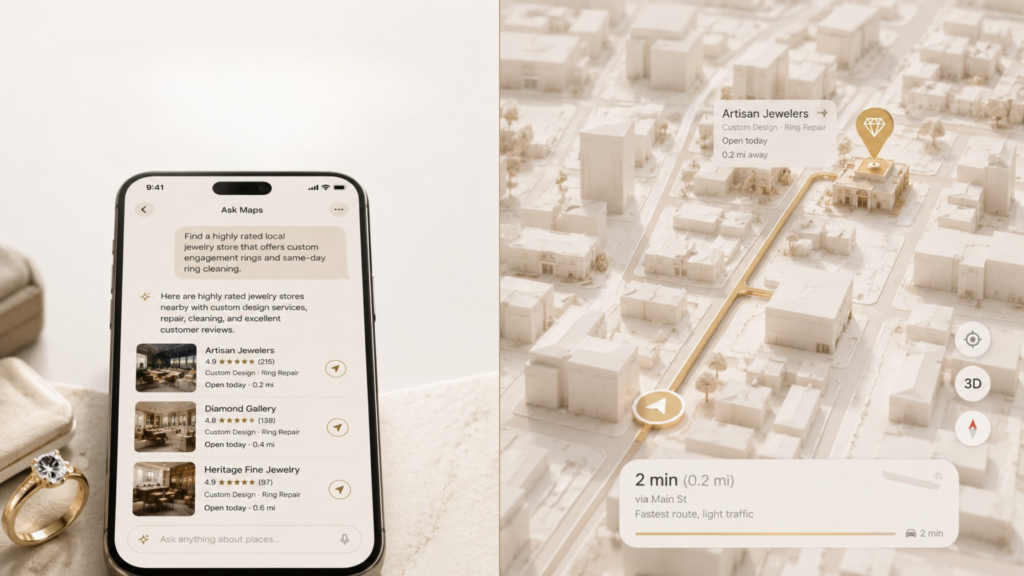
Ask Maps turns search into a conversation. Rather than matching a keyword, it interprets a layered request and returns recommendations that satisfy every condition at once. Google says the feature draws on more than 300 million places and reviews from over 500 million contributors, and that it personalizes answers using signals like the places someone has already searched for or saved.
That personalization detail deserves a second read. In a category built on repeat clients and multi-year relationships, a customer who has saved your store or searched your name carries that history into every question they ask afterward.
Immersive Navigation rebuilds the driving view in 3D. It replaces the flat map with rendered buildings, overpasses, and terrain, and highlights lanes, crosswalks, and traffic signals at complicated intersections. Google also added destination previews built from Street View imagery, parking recommendations, and guidance on which side of the street your entrance sits on.
| Feature | What it does | Why it matters to a jewelry store |
Ask Maps | Answers conversational, multi-condition questions using Gemini models | Determines whether you appear in the recommendation at all |
| Immersive Navigation | 3D driving view with lane guidance and destination previews | Determines how easily a customer actually reaches your door |
| Destination preview | Street View imagery, parking guidance, entrance highlighting | Shapes first impressions before anyone parks |
Ask Maps is the one to plan around. Immersive Navigation is a convenience layer that shortens the distance between finding you and walking through the door.
Why AI-Driven Local Search Raises the Stakes for Jewelers
Local discovery has always driven a large share of Maps behavior, and jewelry sits squarely inside it. Most fine jewelry purchases still involve someone walking through a door to see the piece in person, under real light, on a real hand.
What changed is qualification. Traditional local SEO rewarded proximity and relevance to a short keyword. Ask Maps evaluates a longer list of conditions before it recommends anyone:
- Does this store carry the category the person described?
- Do the services they need actually appear on the profile?
- Are the hours current for the day and time being asked about?
- Do the reviews reflect the experience being requested?
- Is the information consistent enough to trust?
Miss any one of those and you do not rank lower. You are left out of the answer entirely. A map pack at least showed three names and let the shopper choose among them.
The upside is qualification quality. Someone who arrives through a detailed conversational query has already described their timeline, their occasion, and usually the exact category they want. They walk in closer to a decision than a shopper who typed two words.
How Ask Maps Reads Your Google Business Profile
Ask Maps pulls from your Google Business Profile and your review content to match your store against complex questions. Treat that profile as source material rather than a directory listing. It is what an AI system reads before deciding whether to mention you.
| Profile element | What Ask Maps takes from it | Common gap at jewelry stores |
| Business category and attributes | Whether you fit the request type | Set as “Jewelry Store” only, with no secondary categories |
| Services list | Repair, appraisal, custom design, watch service | Left blank, or listed on the website only |
| Products | Brands, categories, price context | Rarely populated at all |
| Reviews | The language customers use to describe you | No responses, no recent volume |
| Hours and special hours | Availability at the moment of the query | Holiday hours never updated |
| Photos | Visual proof of inventory and space | Stale exterior shots from years ago |
| Q&A | Direct answers to common questions | Unmonitored, or answered by strangers |
Review language carries more weight than most owners expect. When customers repeatedly mention custom design, watch service, or an unhurried appointment, that vocabulary becomes evidence a model can match against. Shape it deliberately. Ask for reviews in a way that invites specifics, rather than hoping the right words accumulate on their own.
How to Tell If Ask Maps Is Sending You Customers
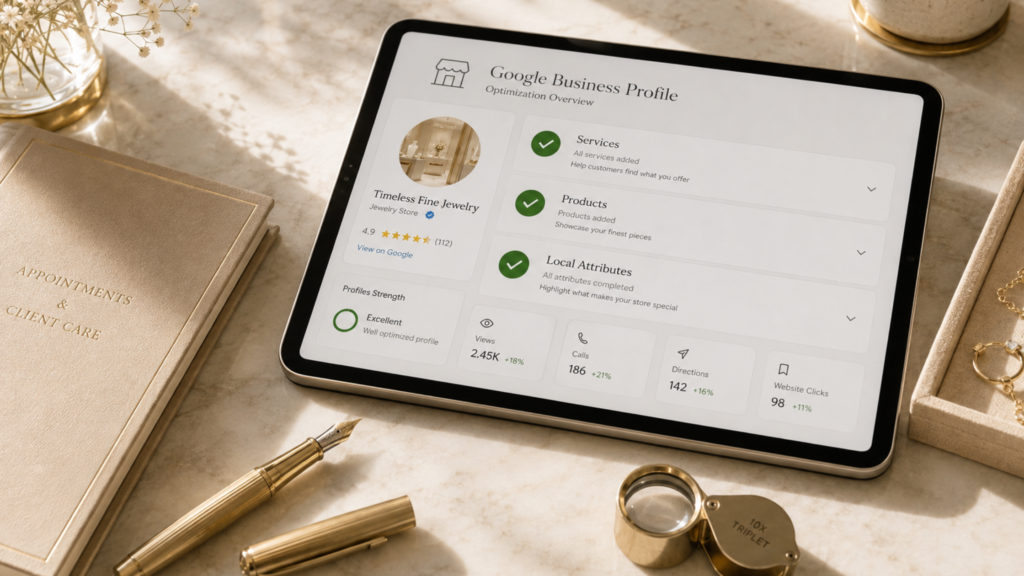
Here is the part most coverage skipped. Ask Maps activity does not appear as its own line in Google Business Profile reporting. Impressions from conversational queries fold into standard Maps impressions, which means no dashboard currently tells you how often an AI answer named your store.
That has two practical consequences.
Judge performance by outcomes, not by a new metric. Watch direction requests, phone calls, appointment bookings, and website clicks originating from Maps. Those move whether or not the reporting ever catches up.
Test the system yourself. Ask Maps the questions your customers actually ask. A jeweler who does same-day sizing. A store carrying pre-owned Rolex. Somewhere to reset an heirloom stone. Note whether you appear, how you are described, and which competitors surface beside you. Repeat it monthly. Until Google breaks out the data, that manual audit is the closest thing to reporting that exists.
What Immersive Navigation Means for Foot Traffic
Immersive Navigation sounds cosmetic, and for a freestanding store on a main street it largely is. For a jeweler inside a shopping center, a plaza, or a mixed-use block, it does real work:
- Entrance clarity reduces the number of people who circle the block and give up.
- Parking guidance removes a real objection for stores in dense retail corridors.
- Street View previews mean your storefront gets evaluated before anyone arrives.
The last point carries the most weight. Outdated Street View imagery, a former tenant’s signage, or scaffolding from a renovation hands a customer an impression of your store that has nothing to do with what is inside it. Requesting updated imagery takes minutes and pays off far out of proportion to the effort.
What Jewelry Stores Should Fix This Quarter
Work in this order. Each step feeds the next.
- Complete every profile field. Categories, services, products, attributes, and hours. Empty fields are missing evidence. Our guide on getting your jewelry business set up on Google Maps covers the setup sequence.
- Build a review request habit. Ask after the pickup, not the purchase. Respond to every review in your brand’s voice.
- Add structured data to your site. Product schema markup gives search and AI systems an unambiguous read of your inventory instead of leaving them to infer it from page copy.
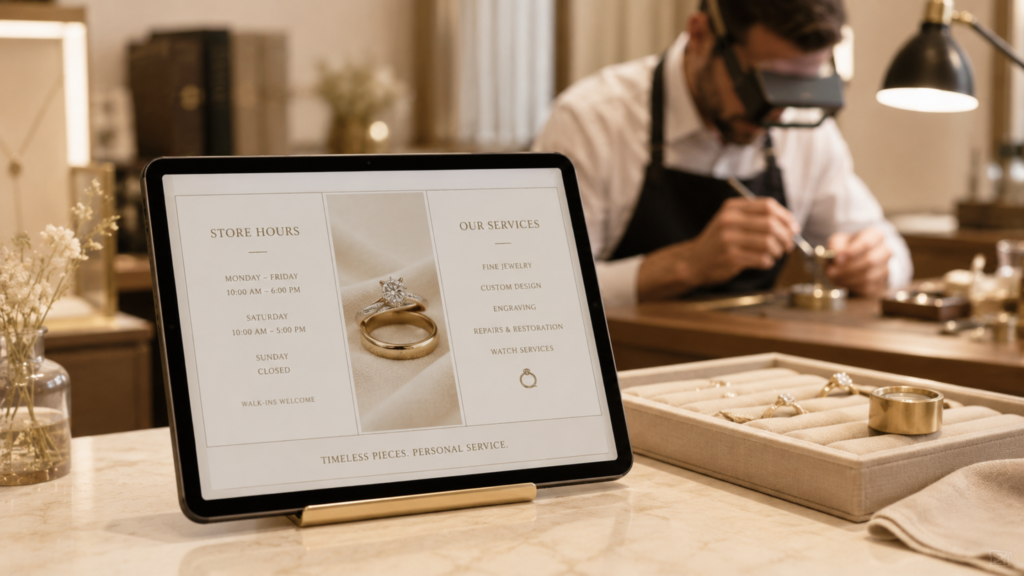
- Load seasonal hours before the season. Engagement season and the holiday stretch are exactly when conversational queries turn urgent: open past six, open Sunday, open Christmas Eve. Special hours entered in December are already late.
- Audit how AI reads your website. Ask Maps is not the only system evaluating you. Check whether your site is readable by AI across the tools shoppers now use.
- Strengthen the fundamentals underneath. Relevance, distance, and prominence remain the foundation the AI layer sits on, and our SEO guide for jewelers covers how those signals get built.
- Tie it to a local plan. These local SEO strategies built for jewelry businesses connect profile work to actual lead volume.
How ARKTOP Approaches Local Visibility for Jewelers
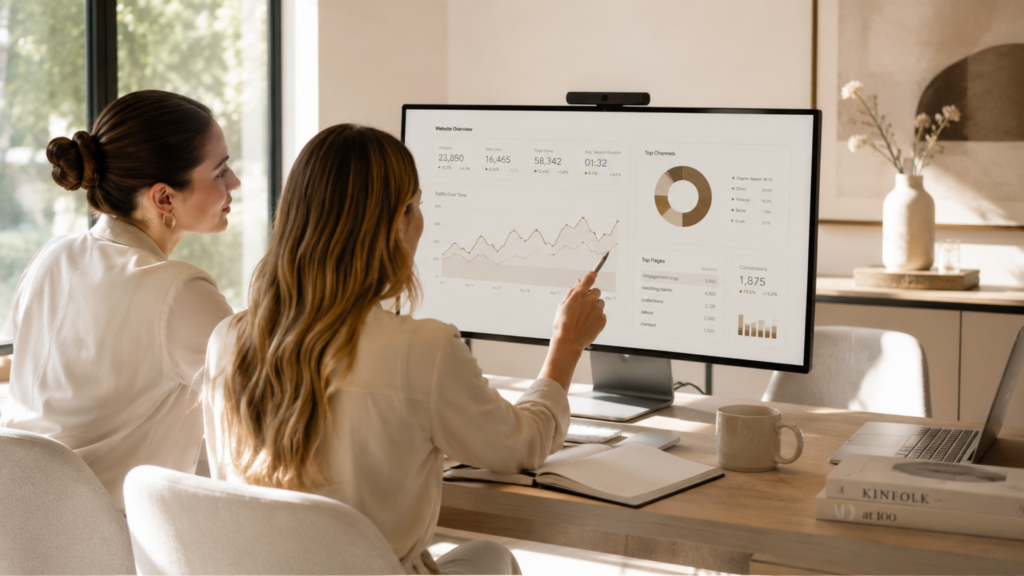
Profile optimization is easy to start and easy to abandon. The stores that hold visibility treat it as an ongoing discipline: a monthly cadence of reviews, photos, hours, and audit checks rather than a one-time cleanup.
ARKTOP works with independent jewelers and Rolex Official Jewelers, including Hamra Jewelers, on this kind of foundational visibility work.
Our luxury SEO services address technical structure, local presence, and the content signals AI systems read. Where that visibility needs to turn into booked appointments and closed sales, our jewelry marketing services carry it the rest of the way.
What This Means for Your Store
The Google Maps update did not make local search harder. It made it more specific. Stores with complete, current, well-reviewed profiles get described accurately to people already looking for exactly what they sell. Stores with thin profiles get passed over silently, with no notification and no lost-ranking report to explain what happened.
Open Maps and ask it the question your best customer would ask. If your store is not in the answer, or the description does not sound like you, that is the conversation to have with us.
Frequently Asked Questions
What is the Google Maps Ask Maps update?
In March 2026, Google introduced Ask Maps, a Gemini-powered conversational search feature, alongside a redesigned Immersive Navigation experience with 3D visuals and real-time guidance. Ask Maps is now widely available in the U.S. and India on Android and iOS, with desktop support announced but not yet live.
How does Ask Maps affect local jewelry stores?
Ask Maps evaluates detailed, conversational questions rather than short keywords. It draws on your Google Business Profile and review content to decide whether your store fits the request, which means incomplete profiles get left out of recommendations entirely rather than simply ranking lower.
Do I need to change my Google Business Profile because of this update?
You do not need a new strategy. You need to finish the one you have. Fill in services, products, attributes, and secondary categories, keep hours current including holidays, and add recent photos. Every empty field is information the AI cannot use on your behalf.
Can I track how often Ask Maps recommends my store?
Not directly. Ask Maps impressions are folded into standard Maps impressions in Google Business Profile reporting rather than broken out separately. Track direction requests, calls, and bookings from Maps instead, and run your own monthly queries to see how your store is being described.
Does Immersive Navigation help my jewelry store get more customers?
Indirectly, yes. It highlights building entrances, recommends parking, and lets people preview a destination through Street View before they arrive. That shortens the distance between finding you and reaching your door, which matters most for stores in plazas and dense retail corridors.
Will Ask Maps replace traditional local SEO for jewelers?
No. Relevance, distance, and prominence still drive Maps visibility. Ask Maps adds an interpretation layer on top of those signals, which makes strong local SEO fundamentals more valuable, not less.
How often should I update my Google Business Profile?
Treat it as a monthly routine at minimum. Refresh photos, post updates, respond to new reviews, and confirm hours ahead of holidays and extended shopping seasons. Profiles that stay active hold visibility better than profiles that go quiet.