A Strategic Guide for Jewelers and Diamond Retailers
If you’re in the diamond business, you’ve likely heard of the Rapaport Diamond Report. But knowing it exists and knowing how to use the Rapaport Diamond Report strategically are two very different things.
For retailers, wholesalers, and luxury jewelers, the Rapaport Price List is not just a pricing sheet, it’s a negotiation framework, inventory benchmark, and margin planning tool.
In this guide, we’ll break down how the Rapaport Diamond Report works, how to interpret it correctly, and how to use it strategically in your diamond pricing model
What Is the Rapaport Diamond Report?
The Rapaport Diamond Report (often called “Rap Sheet” or “Rap List”) is a weekly diamond pricing benchmark that lists asking prices for round brilliant diamonds based on:
- Carat weight
- Color grade
- Clarity grade
Prices are listed per carat and serve as a baseline for wholesale diamond transactions.
Important: The Rapaport list is not the final transaction price. It is a benchmark. Most diamonds trade at a discount (or occasionally premium) to Rap.
Understanding this distinction is critical.
Why the Rapaport Report Matters
The Rapaport Diamond Report is widely used because it creates a common pricing language within the diamond industry.
It helps:
- Standardize wholesale negotiations
- Benchmark inventory pricing
- Guide buying decisions
- Anchor retail pricing strategy
For luxury retailers like Hamra Jewelers, pricing isn’t just about market rate it’s about positioning. The Rapaport list provides structure, but brand equity influences final retail pricing.
How to Read the Rapaport Diamond Price List
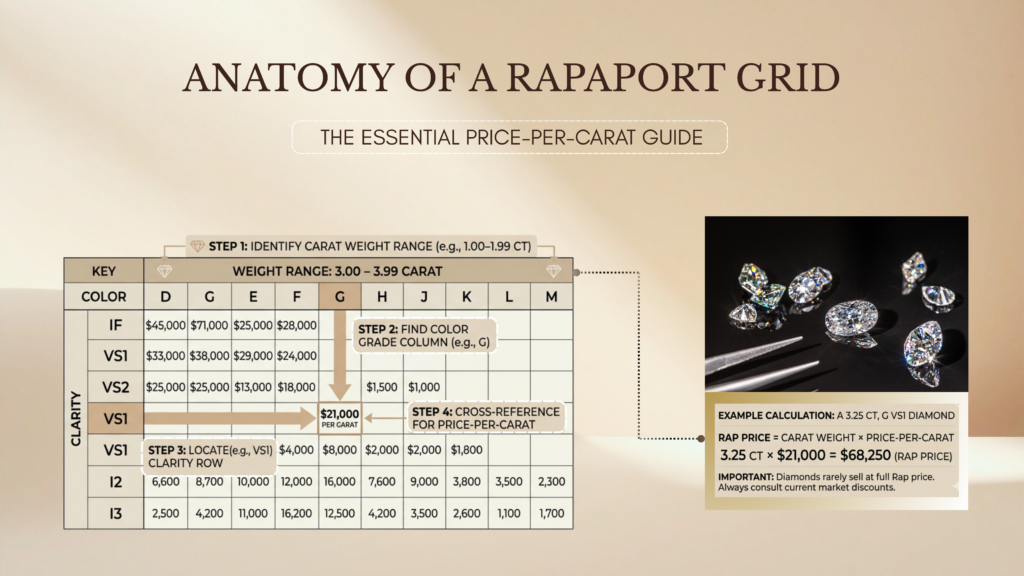
The Rapaport sheet is structured in grids.
Here’s how to interpret it:
- Identify the diamond’s carat weight range.
- Find the color grade column (D–M).
- Locate the clarity row (IF–I3).
- Cross-reference the intersection for the price per carat.
For example:
If the Rap price for a 1.00–1.49 ct G VS1 diamond is $8,000 per carat, and the stone weighs 1.20 ct:
1.20 × $8,000 = $9,600 (Rap price)
However, diamonds rarely sell at full Rap
Understanding Rap Discounts
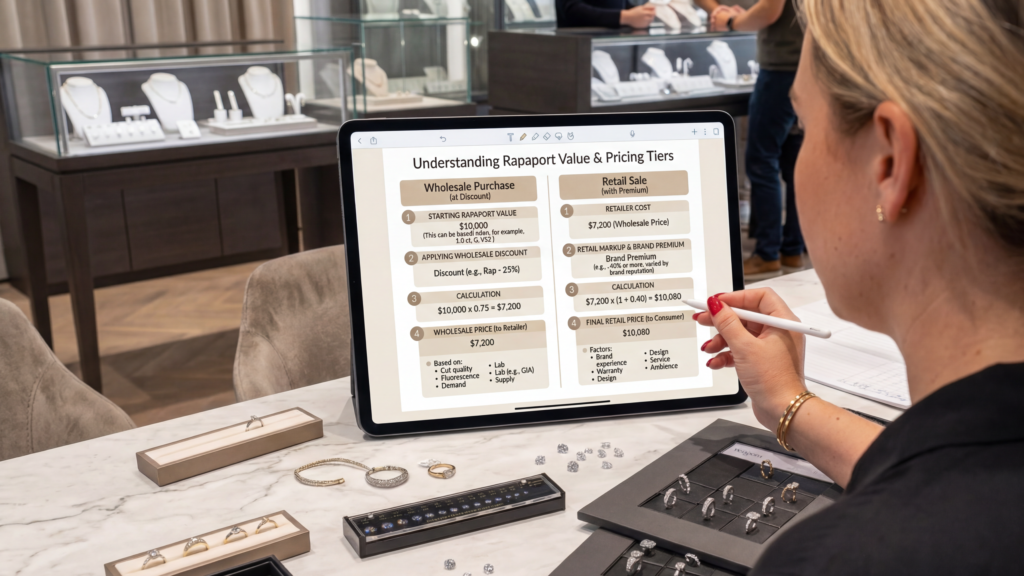
In real transactions, diamonds trade at a discount to Rap.
For example:
A diamond might trade at “Rap minus 25%.”
Using the example above:
$9,600 × 0.75 = $7,200
This would be the approximate wholesale price.
Discount levels vary based on:
- Cut quality
- Fluorescence
- Market demand
- Certification lab (GIA vs others)
- Supply conditions
Understanding market discount trends is crucial for protecting margins.
How to Use the Rapaport Report Strategically
Most articles stop at explaining the math. That’s not enough.
Here’s how professionals actually use it.
1. Inventory Buying Decisions
Before purchasing inventory, compare:
- Current Rap price
- Market discount
- Historical price shifts
Buying at the wrong time can compress margins quickly.
Retailers who combine Rap data with strong SEO for jewelers strategies can turn inventory insights into high-margin online conversions.
2. Retail Pricing Framework
Rap is wholesale-focused, but it influences retail anchoring.
Retail pricing should consider:
- Rap benchmark
- Wholesale discount
- Operating overhead
- Brand positioning
- Customer perception
Luxury brands rarely price directly off Rap. Instead, they use it as internal guidance while maintaining brand-aligned margins.
For example, Hamra Jewelers integrates pricing intelligence with premium brand positioning ensuring diamonds reflect both market value and luxury experience.
3. Negotiation Leverage
When negotiating with suppliers, referencing Rap provides:
- A common industry language
- Clear anchor points
- Stronger leverage during bulk buying
However, relying solely on Rap without understanding live market conditions can result in overpaying.
4. Market Trend Monitoring
Rap prices shift weekly based on:
- Supply fluctuations
- Global demand
- Economic factors
Monitoring these shifts helps jewelers anticipate margin changes and adjust pricing accordingly.
This is especially important when aligning inventory planning with your broader digital marketing strategy and seasonal campaign pushes.
Common Mistakes When Using the Rapaport Diamond Report
Avoid these pitfalls:
- Treating Rap as final market value
- Ignoring cut quality variations
- Overlooking certification differences
- Failing to account for local demand
- Pricing retail directly off Rap without margin modeling
Rap is a tool not a pricing rulebook.
Rapaport vs. RapNet: What’s the Difference?
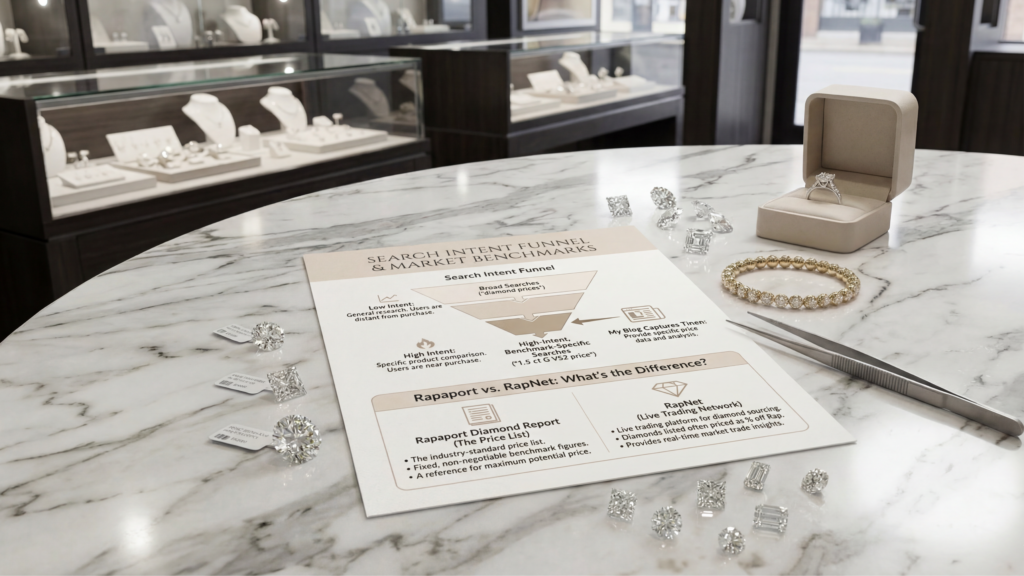
The Rapaport Diamond Report is the price list.
RapNet is a live diamond trading network where suppliers list diamonds, often priced at a percentage off Rap.
RapNet provides real-time insight into how stones are traded relative to the benchmark.
Understanding both helps jewelers stay competitive in sourcing.
How SEO and Digital Strategy Influence Diamond Sales
Understanding Rap is only half the equation.
If customers can’t find you online, pricing expertise won’t matter.
High-intent buyers search for:
- “1 carat G VS1 diamond price”
- “GIA certified diamond near me”
- “Diamond engagement ring pricing guide”
Optimizing for these terms through strong on-page SEO and structured content allows you to attract buyers who are already price-aware.
Retailers that combine Rap intelligence with strategic search engine marketing consistently outperform competitors relying on foot traffic alone.
Frequently Asked Questions
Is the Rapaport Diamond Report accurate?
The Rapaport list is a benchmark, not a transaction record. Actual diamond prices vary based on market conditions, cut quality, and negotiated discounts.
How often is the Rapaport list updated?
The report is typically updated weekly to reflect shifts in supply and demand.
Do retailers price diamonds directly from Rap?
No. Retailers use Rap as a baseline reference but factor in overhead, brand positioning, and customer experience before final pricing.
What does “Rap minus 20%” mean?
It means the diamond is selling at a 20% discount to the listed Rapaport benchmark price.
Is Rapaport useful for consumers?
While consumers can use it for general reference, Rapaport is primarily designed for industry professionals and wholesale transactions.
Turning Diamond Intelligence Into Growth
Knowing how to use the Rapaport Diamond Report gives you pricing intelligence. But combining that knowledge with strategic marketing creates growth.
Luxury jewelers like Hamra understand that pricing expertise must align with brand authority, online visibility, and digital performance.
If you’re ready to align your diamond pricing strategy with SEO, paid advertising, and high-converting digital experiences, ARKTOP can help you build a performance-driven system that supports long-term growth.
Schedule a consultation with ARKTOP today and elevate your diamond retail strategy.