
Most jewelry marketers found their way to AI through one front door: ChatGPT. It writes product descriptions, drafts emails, brainstorms campaign angles, and answers questions at any hour. So why look anywhere else?
Because one tool rarely fits every job. The AI landscape has grown fast, and several platforms now do specific tasks better than a single all-purpose assistant. Some research live information across the web. Some generate images for your social feed. Some sit quietly inside your existing workflow and handle the repetitive work that eats your day.
This guide walks you through the best other sites like ChatGPT, what each one does well, and how a luxury jewelry brand can put them to work. By the end, you will know which tools belong in your marketing stack and why having more than one matters.
Why Look for Other Sites Like ChatGPT

ChatGPT is excellent, but it is not the only option, and it is not always the right one. Relying on a single AI tool is a bit like owning one ring and wearing it to every occasion. It works, but you are leaving better-suited choices in the drawer.
Here is why smart jewelry marketers explore alternatives:
● Different strengths for different tasks. Some tools write beautifully, others research in real time, and others create visuals. Matching the tool to the task raises the quality of everything you produce.
● Live, current information. ChatGPT’s knowledge has limits around how recent its information is. Several alternatives pull live data from the web, which matters when you are tracking trends or seasonal demand.
● Built-in integrations. Some AI tools live inside the software you already use, from your browser to your design platform, so you spend less time copying and pasting.
● Visual content. For a jewelry brand, imagery is everything. Certain AI platforms specialize in generating images and graphics, which ChatGPT handles only in part.
● Cost and access. Different pricing models suit different budgets, and trying a few helps you find the best value for your needs.
The goal is not to abandon ChatGPT. The goal is to build a small, sharp toolkit where each tool earns its place. If you want to make sure the content these tools help you create is actually discoverable, our guide on whether your site is readable by AI is a smart next read.
The Best ChatGPT Alternatives for Jewelry Marketers
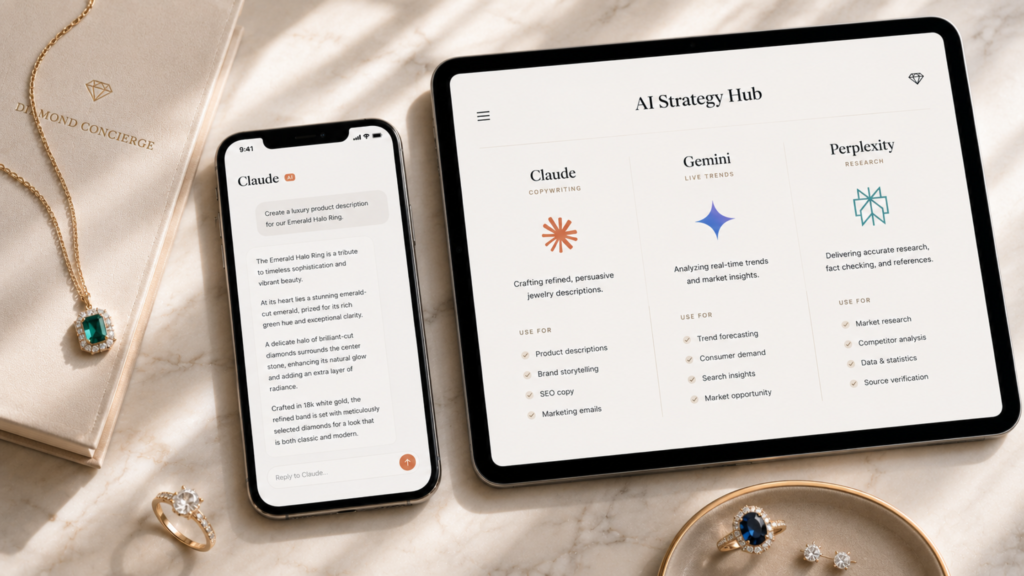
Below are the AI tools worth knowing, grouped by what they do best. Each one fills a gap that a single assistant cannot cover on its own.
Claude
Claude is a conversational AI known for thoughtful, natural writing and a strong grasp of nuance. For jewelry marketers, it shines at long-form content like blog posts, brand storytelling, and polished product descriptions that need to feel elevated rather than generic.
● Handles long documents and detailed instructions well
● Produces warm, refined copy that suits a luxury voice
● Strong for editing and refining content you have already drafted
Google Gemini
Gemini is Google’s AI, and its biggest advantage is integration with the wider Google ecosystem. It connects to Search, which means it can pull current information rather than relying on older training data.
● Pulls live, up-to-date information from the web
● Works smoothly alongside Google Workspace tools
● Useful for research, trend-spotting, and quick fact-checking
If your marketing leans on Google Ads, understanding how AI is reshaping that platform is worth your time. Our breakdown of Google’s AI Max upgrade covers what is changing and how to prepare.
Microsoft Copilot
Copilot brings AI directly into the Microsoft tools many businesses already run on, from Word to Excel to Outlook. For a jewelry brand that lives in Microsoft 365, it removes the friction of switching between apps.
● Built into familiar Microsoft software
● Helps draft documents, summarize emails, and analyze spreadsheets
● Free access available through the web and mobile apps
Perplexity
Perplexity functions more like an AI search engine than a chatbot. It answers questions with current information and cites its sources, which makes it valuable for research you need to trust and verify.
● Provides live answers with linked sources
● Excellent for competitive research and market questions
● Reduces the guesswork around where information came from
Jasper
Jasper is built specifically for marketing teams. It is designed around campaigns, brand voice, and high-volume content production, which makes it a fit for brands publishing across many channels at once.
● Purpose-built for marketing and ad copy
● Stores and applies your brand voice across content
● Useful for scaling social posts, emails, and product descriptions
Comparing the Top AI Tools at a Glance
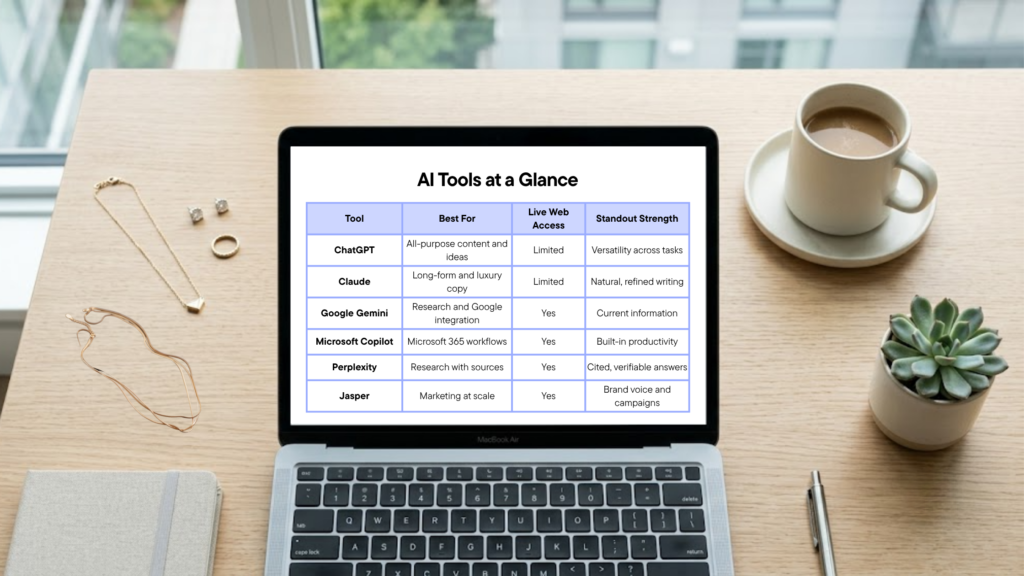
Different tools win at different jobs. This table gives you a quick, scannable view of where each one fits so you can decide what belongs in your stack.
| Tool | Best For | Live Web Access | Standout Strength |
| ChatGPT | All-purpose content and ideas | Limited | Versatility across tasks |
| Claude | Long-form and luxury copy | Limited | Natural, refined writing |
| Google Gemini | Research and Google integration | Yes | Current information |
| Microsoft Copilot | Microsoft 365 workflows | Yes | Built-in productivity |
| Perplexity | Research with sources | Yes | Cited, verifiable answers |
| Jasper | Marketing at scale | Yes | Brand voice and campaigns |
The takeaway is simple: there is no single best tool. There is the right tool for the task in front of you, and most marketers benefit from keeping two or three on hand.
How to Use AI Tools in Your Jewelry Marketing

Picking the tools is the easy part. Using them well is what separates polished brands from the ones that sound like everyone else. Here is how to put these AI tools for jewelers to work without losing the human touch that luxury demands.
● Use AI writing tools for first drafts, not final copy. Let the tool give you a starting point, then refine it in your own brand voice. AI is a strong collaborator and a poor replacement for editorial judgment.
● Match the tool to the task. Reach for a research tool when you need facts, a writing tool when you need words, and an image tool when you need visuals.
● Feed it good information. The quality of what you get back depends on the quality of what you put in. Specific prompts produce specific, useful results.
● Always review before publishing. AI can get details wrong, especially around pricing, gemstone facts, and current trends. A human check protects your credibility.
● Keep your brand voice consistent. Luxury buyers notice when content feels generic. Use AI to work faster, then polish until it sounds unmistakably like you.
Generative AI for marketing works best as part of a thoughtful strategy, not a shortcut around one. If you want to ground your efforts in fundamentals, our overview of content marketing explains how strong content supports every channel you run. For a wider view of the platforms worth knowing, our roundup of digital marketing tools and resources for jewelers is a useful companion.
Where ARKTOP Fits In

AI tools can draft, research, and generate, but they cannot tell you what makes your market tick. They do not know your buyers, your competitors, or the difference between a piece that sells and one that sits in the case. That understanding comes from experience, and it is where the right partner makes the difference.
At ARKTOP, we help jewelers turn technology into results. We have worked with respected names like Hamra Jewelers and Rolex Official Jewelers, and we know how to blend smart tools with genuine strategy. Whether you are exploring AI for the first time or refining an existing approach, we make sure your marketing reflects the quality of your craftsmanship.
That includes making sure your content is built to be found, both by people and by the AI search engines that increasingly shape how buyers discover brands. Our jewelry marketing services and luxury SEO work are designed to put your brand in front of the right buyers at the right moment.
Building Your AI Toolkit
ChatGPT opened the door. It does not have to be the only tool you reach for. The best ChatGPT alternatives each bring something different to the table, from live research to polished writing to marketing built for scale. The smartest move is not picking one. It is building a small toolkit where each tool pulls its weight.
Not sure which AI tools are worth your time? Schedule a consultation with ARKTOP and let’s figure out which tools actually belong in your marketing.
Frequently Asked Questions
What are the best other sites like ChatGPT for marketing?
Some of the strongest ChatGPT alternatives for marketing include Claude for long-form writing, Google Gemini for research, Perplexity for sourced answers, and Jasper for campaign content. Each one specializes in a different task, so the best choice depends on what you are trying to accomplish. Many marketers use two or three together.
Are ChatGPT alternatives free to use?
Many AI tools offer free versions with useful features, including Google Gemini, Microsoft Copilot, and the basic tiers of ChatGPT and Claude. Paid plans typically unlock higher usage limits, advanced features, and faster responses. Trying the free versions first is a smart way to find what fits your needs before committing.
Which AI tool is best for writing jewelry product descriptions?
Claude and Jasper are both strong choices for product descriptions, with Claude offering refined, natural writing and Jasper providing brand-voice consistency at scale. Whichever you choose, always edit the output to match your brand’s tone and verify any factual details. AI gives you a solid first draft, and your judgment makes it shine.
Can AI tools help my jewelry website show up in search?
Yes, AI tools can support your search visibility, but how your site is built and written matters just as much. AI search engines and traditional search both reward clear, well-structured, trustworthy content. Pairing good AI tools with sound SEO practices gives your brand the best chance of being found.
Do I need more than one AI tool?
Most marketers benefit from using a few AI tools rather than relying on just one. Different platforms excel at different tasks, so a small toolkit lets you match the right tool to each job. Start with two or three that cover writing, research, and visuals, then adjust as you learn what works.
More from the blog
Your brand deserves a partner fluent in luxury.
A 30 minute strategy call. We come with a first read of your site, search, and ads.